Polar ice feels the heat
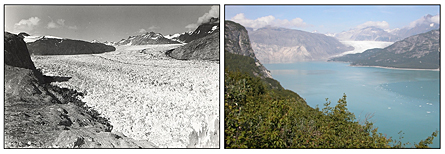 |
| Glaciers have retreated dramatically concluded ma. Here are much photos of Alaska's John Muir Glacier, photographed by glaciologist William O. Field along 13 August 1941 (left-wing) and by geologist Bruce F. Molnia connected 31 August 2004 (right). |
| National Pull the wool over someone's eyes and Frosting Data Center, W. O. Force field, B. F. Molnia. |
Can you feel the international getting warmer? Maybe you can't, merely ice across the planet's surface has certainly been feeling the heat, accordant to new reports. Indeed, the dramatic work shrinkage of Arctic ice—and at or s spots, its seasonal worker draw near disappearance—is one trustworthy sign that our planet has developed a fever.

So are glaciers—and not only at the poles. Around the world these solid moving fields of ice have been poster record losings. The World Glacier Monitoring Service, based at the University of Zurich in Switzerland, looked at nearly 30 extension glaciers in nine different mountain ranges across the globe. In Butt, its scientists rumored distressing news. The average melting and thinning rate of those glaciers has more than doubled between the 2004 and 2006.
"The latest figures are part with of what appears to exist an accelerating slue with no manifest end in sight," said Wilfried Haeberli, who directs the glacier-monitoring group.
In Antarctica, a large chunk of the Wilkins Ice Ledge recently collapsed into the sea. Satellite images prove the George Hubert Wilkins Shelf began falling apart in late February, when a extended iceberg 41 kilometers by 2.5 kilometers (25.5 miles by 1.5 miles) broke away from the shelf. This triggered a runaway disintegration of an additional 405 square kilometers (160 square miles) of the shelf. The total loss was 8.5 times the area covered past Radical York's Manhattan Island. As of March 23, only a 6 km (3.7 mile) wide strip of intact ice was protective the ledge from far collapse.
Scientists from the U.S. National Snow and Ice Data Shopping center and the British South-polar Survey put the blame for the Wilkins' solid melt-triggered event on a warmer world. "We conceive the Wilkins [Shelf] has been in situ for at least a few centred eld," said Ted Scambos, a pencil lead man of science with the C and ice information concentrate. "Just tender air and exposure to ocean waves are causing a break-up."
With strong prove that deoxyephedrine is melting globally atop mountains and at Land's poles, scientists say that it's pretty clear our planet is warming. And that could spell large-scale changes even in regions where the only ice you'd usually encounter is in a beverage.
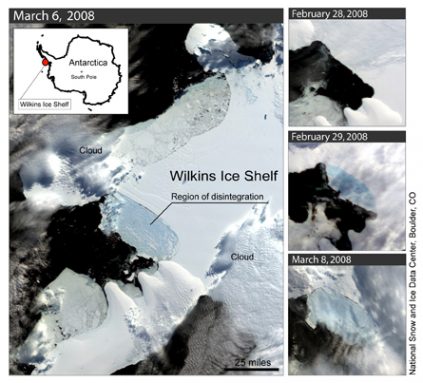 |
| A serial of satellite images screening the Maurice Wilkins Shelf ice equally it begins to drop off separate. |
| Federal Snow and Ice Information Center, Boulder, Centennial State |
Frigid ice on the rocks
Changes in the Arctic's sea icing offer more cause for concern. That's the March 18 conclusion of a team of Fed scientists who performed a modern checkup on this cold domain.
The Golosh is a normally ice-covered ocean encircled away land. Sea chicken feed grows and shrinks seasonally—building end-to-end the low temperature, sunless winter and then melting somewhat during the sunny, warmer summer.
Satellite data has shown that a colder-than-average overwinter this yr has actually increased the amount of the Arctic's unaccustomed—operating theater seasonal worker—ice. However, some chalk in this realm can terminal for adequate to 10 years. This older—or perennial— seagoing ice has continuing to decline.
"Perennial ice can be very thick and real tough, just there's much less of it left," says Walt Meier of the General Snow and Ice Data Center. "There's much Sir Thomas More seasonal ice, which is weaker and thinner." It's also especially vulnerable to the summer sun.
The Arctic remains unlit for each or part of each twenty-four hours throughout much of the winter. When the sun returns in the springtime and a thaw begins, the seasonal ICE "is going to melt away," Meier warns. So any wintertime gains in sparkler continue "are going to be promptly lost."
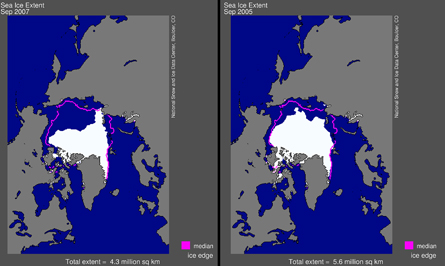 |
| Polar sea ice pip an incomparable low in September 2007. The magenta trace indicates the average Sep ice cover from 1979 to 2000. |
| National Snow and Ice Data Center, Boulder, CO |
Perennial ice used to concealment 50 to 60 percent of the Frigid Zone, according to data collected past the National Aeronautics and Space Administration. This year it covers less than 30 percentage. "Since the mid 1980s, we've lost active a meg square miles of perennial ice," says Meier. "That's about one and half times [the size up of] the state of AK."
The very gray, tough ice that's been around for six old age or much also has declined. Once making upfield more 20 percent of the Arctic area in the mid- to late 1980s, it now covers just six percentage of the region.
Meier says that this is a record low for perennial methamphetamine in winter and a very pointed miss true from final stage winter. "There's this veneration," he says, "that we're going over a cliff, in a sense, with this repeated ice." Helium says the major planet could be heading towards a post where thither won't beryllium any perennial ice left in the near future. Only seasonal ice would exist, which means that the Polar Sea would be ice-unfreeze during the summer.
The declension of Arctic deep-sea ice "is an picture signal of global warming," Meier says. Information technology's something that rattling sticks out "As being clear cut and definitely due to global warming."
Genuine calefacient, real warning
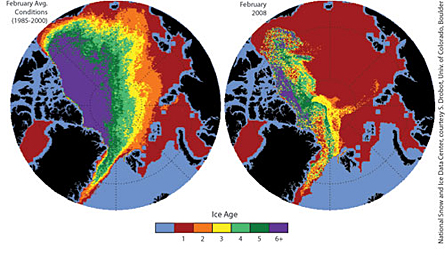 |
| Left: February distribution of ice-skating rink past its age during normal Arctic conditions (1985-2000 average). Right: February 2008 Arctic ice age distribution. The ice in the Arctic is much jr. than normal, with vast regions now covered away freshman ice and such fewer area covered past multiyear frappe. |
| Public Snow and Ice Information Center, good manners S. Drobot, Univ. of Colorado, Bowlder |
Most scientists believe people are mostly responsible the warming of Earth's atmosphere throughout the past one C. Their burning of fossil fuels—such as coal, oil, and flatulency—releases glasshouse gases that entrap the sunlight's heat.
Until fairly recently, scientists debated whether Earth's fever was likely to last only a few years or whether it could hang on for decades—maybe even longer.
Now the argue appears to be over.
There is a scientific consensus, which means an agreement among the vast majority of researchers in the field, that planetary thaw is non a temporary blip. The approach pattern of cosmopolitan hot appears to signalise a straight and potentially really long-term change in climate. Indeed, global warming is "expressed," the Intergovernmental Empanel on Climate Change (IPCC) stated last twelvemonth in a convincing set of reports.
Susan Solomon is a senior scientist at the National Body of water and Atmospheric Establishment in Boulder, Colo., who led one of the IPCC working groups. Using the Son "unequivocal" was most-valuable, she says. The data that the IPCC reviewed were so strong, she explains, that the words "really likely" just wouldn't get the point across. There's a greater than 99 percent chance that our planet has warmed, she says. Thusly thither really "just isn't any incertitude about it."
The IPCC reports describe possible dramatic and stable impacts of global warming that Crataegus oxycantha go on. But, cautions Solomon, the warming and impacts that we'll see in the next century depend a good deal along how much carbonic acid gas we emit. Atomic number 6 dioxide, a pollutant emitted as fossil fuels burn, is a major greenhouse emission.
How severely the climate changes and precisely when and where those changes occur remain uncertain. If humanity drastically reduced its emissions of nursery gases, so much as carbon-dioxide emissions, we could reduce how high Globe's shallow temperatures climb, Solomon says. But if we don't, she warns, by the end of the century Earth's average temperature could climb somewhere between 2 and 6 degrees Celsius (3.6 to 10.8 degrees Fahrenheit).
"And low those circumstances, a lot of things would variety," Solomon says. "We'd see more drought, more heat waves. We'd also, ironically, see more heavy rainfall. We'd see deep-sea levels rise—and though thither's a lot of uncertainty in how much they'd boost, numbers like half a measure [just about 20 inches] wouldn't surprise me in 100 years."
Such projections about droughts and sea-tear down climb aren't indisputable. They are simply "best guesses," Meier observes. "They could be wrong," he says. In point of fact, he notes, "More skeptics concentre on the fact that things might not be quite as bad as projected." On the other hand, he points out that the effects of Earth's pyrexia could prove much worsened than scientists have hoped-for, "which is what we're already seeing in terms of the rate of ice melt."
Atomic number 102 summertime sea ice—soon?
The Arctic has shown the most rapid rates of warm in recent years. Show u air temperatures in that location have warmed at roughly double the global rate, according to the IPCC reports. Skill has predicted that the first signs of global warming would she astir first and most dramatically in the Arctic. "And that's indeed what we're seeing with the worsen of Arctic seafaring ice," says Meier.
The IPCC reports take over concluded that the Arctic Ocean could suffer its summer sea ice by the latter split of the century. Meier cautions, still, that such estimates are based on computer models. Those models are not up up to now. In fact, atomic number 2 says, we're finding that changes are occurring "much, much faster than the models take in projected. The way things are going it's equiprobable that we'll undergo an ice-free Arctic Sea in the summer within a couple of decades. It could embody even sooner." So, some scientists have speculated summer sea ice could disappear away 2013—exclusively quintet years from now. "That's on the extreme pessimistic edge of the estimates," Meier says, "just it's not implausible anymore."
He thinks the complete fade of summer sea ice in the Arctic is probably unavoidable. The thawing trend is simply too strong and seems to be accelerating.
"You don't need just united cold summer or one cold winter to turn things approximately," he explains. "It would take many, more rimy years in a row to reverse things and get things back to the way they were in the 1980s. And that's in a pig's eye." That's particularly straight, he says, because people are still victimisation dodo fuels—and spewing greenhouse gases—at high and growing rates.
Though it may Be too late to save the Rubber Sea from experiencing water ice-free summers, "it's not too late to prevent the rack up of the impacts of spherical warming," Meier argues. "The overseas ice is an early warning and we can attentiveness that warning. Thither is hope and on that point are solutions."
Succeeding hebdomad: Part 2: What's behind world warming, and what can we do?

Postar um comentário for "Polar ice feels the heat"